

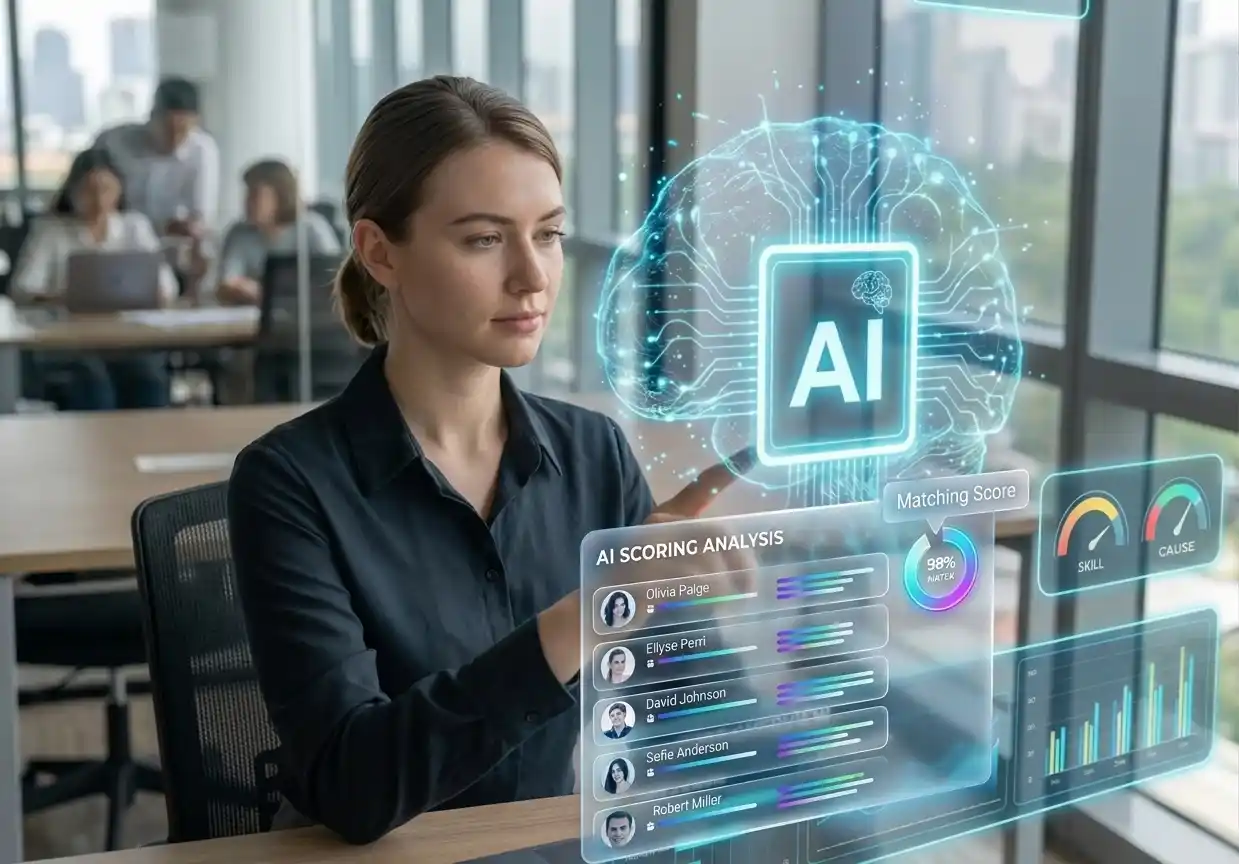
Hiring today is not just about finding candidates. It is about evaluating them quickly and accurately.
Take Ahmed, an HR manager at a mid sized logistics company in the GCC, responsible for handling high volume hiring across operations, customer support, and sales roles. A single job posting can bring in over 150 applications within days.
That is where the real challenge begins.
Resumes pile up. Shortlisting takes hours. Different team members evaluate candidates differently. Some strong profiles get missed, while others move forward based on incomplete assessment. By the time decisions are made, the best candidates are often already off the market.
This is where AI scoring starts to make a real difference.
AI scoring helps recruiters evaluate candidates using structured data instead of guesswork. It brings clarity to candidate shortlisting and makes hiring decisions faster and more consistent.
Let’s break it down simply.
AI scoring is a method where candidates are assigned a score based on how well they match a job role. This score is calculated using factors like skills, experience, qualifications, and sometimes even interview responses.
For Ahmed, this changes the starting point of hiring.
Instead of going through hundreds of resumes one by one, he sees a ranked list of candidates based on relevance. The system highlights the strongest matches first, allowing him to focus on evaluation rather than filtering.
AI scoring does not replace recruiters. It supports them by organizing and prioritizing information in a way that makes decision making clearer and faster.
Before AI scoring, most candidate shortlisting relied on manual processes.
Recruiters scan resumes, look for keywords, and decide who moves forward. While this approach works at a small scale, it breaks down when application volume increases.
Ahmed faces this daily. When hundreds of resumes come in, even experienced recruiters struggle to maintain consistency.
Manual evaluation creates three major issues.
First, it is slow. Screening takes hours or even days.
Second, it is inconsistent. Different recruiters may interpret the same profile differently.
Third, it introduces bias. Even unintentionally, preferences influence decisions.
This leads to delays, missed opportunities, and poor hiring outcomes.
AI scoring systems analyze candidate data and compare it with job requirements in a structured way.
The process typically includes:
Some advanced systems go further by analyzing interview responses, communication patterns, and behavioral indicators.
For Ahmed, this means instead of reviewing 200 applications, he focuses on the top 20 candidates who actually meet the criteria.
This shift reduces effort while improving accuracy.
Candidate shortlisting is where most hiring delays occur.
Without AI, recruiters often rely on basic filters like keywords or years of experience. This can eliminate strong candidates who may not fit traditional patterns but have the right skills.
AI scoring improves candidate shortlisting by going beyond surface level data.
It identifies transferable skills, relevant experience, and overall fit. This allows recruiters to consider a wider range of qualified candidates.
For Ahmed, this creates a more reliable shortlist. Instead of guessing, he works with structured recommendations that make sense.
Bias is one of the biggest challenges in hiring.
Even experienced recruiters can be influenced by factors such as education, previous companies, or personal impressions. This affects fairness and decision quality.
AI scoring helps reduce bias by applying consistent evaluation criteria across all candidates.
Every candidate is assessed using the same parameters. This creates a more balanced and fair hiring process.
That said, AI is not perfect. Recruiters still play a critical role in reviewing and validating decisions.
The goal is not to remove human judgment but to strengthen it.
Speed is critical in hiring. Delays often result in losing strong candidates to competitors.
AI scoring helps HR teams move faster by eliminating manual bottlenecks.
For Ahmed, this means less time spent on screening and more time focused on interviews and final decisions.
Faster processes do not mean rushed decisions. Instead, they create space for better evaluation.
This balance improves both hiring speed and quality.
AI scoring is becoming a key part of the future of work.
As hiring becomes more data driven, organizations will rely on AI to manage complexity and scale. Recruiters will shift from manual screening to strategic decision making.
For Ahmed, this means his role evolves.
Instead of spending hours reviewing resumes, he focuses on understanding candidate potential, aligning with hiring managers, and improving workforce planning.
AI does not reduce the importance of recruiters. It increases their impact.
Despite its benefits, some recruiters hesitate to adopt AI scoring.
One common concern is that AI might overlook good candidates.
In reality, AI scoring improves visibility. It highlights candidates based on relevance, but recruiters still make the final decision.
Another concern is complexity. Many assume AI tools are difficult to use.
Modern platforms are designed to be simple and intuitive. Recruiters can adopt them without technical expertise.
AI scoring works best when supported by the right platform.
Tools like SIAA integrate AI scoring into the recruitment workflow. Features such as resume parsing, matching scores, and structured evaluation help recruiters manage hiring more efficiently.
Instead of switching between multiple tools, everything is handled in one place.
If you want to explore how AI can support your hiring process, check this:
AI Hiring Software
These tools reduce manual effort while improving decision quality.
“AI scoring does not replace recruiters. It helps them see what matters faster.”
AI scoring is not about replacing recruiters. It is about helping them make better decisions faster.
For HR managers like Ahmed, it solves real problems. It reduces manual work, improves candidate shortlisting, and brings consistency to hiring.
In a high volume hiring environment, relying on manual processes is no longer practical.
AI scoring provides a clear path forward. It helps organizations move faster, hire smarter, and stay competitive in a changing hiring landscape.
See how AI powered ATS can transform your hiring process
Book a demo with Siaa. At https://www.siaa.app/
Discover how SIAA’s AI powered ATS can simplify recruitment for your team.
TRY FOR FREE
Hire Faster, Hire Smarter, Hire with Confidence.
© SIAA. All rights reserved.